Showing posts with label pohnpei. Show all posts

20 May 2012

Cutural Heritage

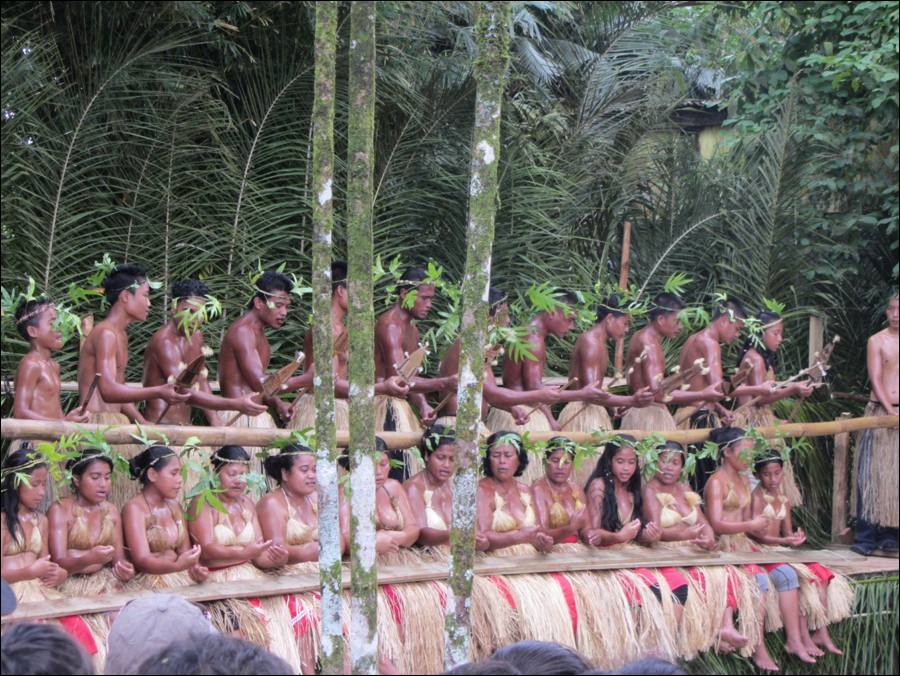
Some of my favorite memories from Micronesia will be the displays of cultural heritage. It makes me a little wistful for my own strong traditions, like doing the hokey pokey. No, I do have stronger and better traditions than that, but not as unified. The intricate dances, stories, chants, songs and weaving that I've seen here on Pohnpei are all truly impressive. These photos are mainly from Culture Day and Yap Day celebrations.


19 May 2012

Better Than the Brochure


Ahnd is a string of atoll islands outside of Pohnpei's lagoon. It is a one to three hour boat ride from Kolonia and well worth the effort. We went camping for three days and two nights with a group of friends. It was amazing!

We each took a meal slot, so I only had to prepare and clean-up from one meal and was served the rest of the time. It was pretty much like car camping as we brought coolers and chairs and had ice for our beverages.


 Kumar's boat

setting up camp 

                                                          catch and release coconut crabs

deluxe tree fort

tent with a view

hammock - the best way to sleep in the rainforest.

The interior of the island is floored with moss-covered corals.

beach butt


father daughter swim

the common kitchen

nap time

The snorkeling is unbelievably spectacular and worth the trip to Micronesia in and of itself.
There are many different crabs and one hitched a ride into the tent on my skirt only to be put off by my screaming like a little girl as it tried to pinch me in the dark. I felt the need to write large letters in the sand "You wish you were Here!", so I did.
We will take home great memories and a few seashells too. 

29 November 2011

The Artless Dodger

Last week, some scumbag(s) broke into our house and stole my laptop and Jamie's camera. We were home at the time, sleeping. The only windows we had open were in our bedrooms; everything else was locked. They took out the screen in our bedroom, quietly slipped past us while we were sleeping, went into the living room and took what they were after, then went back out through the bedroom window.

The dog that hangs out around our house was in heat and had been attracting a number of male suitors, all of whom had been barking like crazy all week, so they were of little help in alerting us to intruders. Not surprisingly, when we reported the break-in, the police were also of little help, and the best they could offer in terms of consolation was to tell us that this kind of thing happens all the time, especially to Americans. They also said that around Christmas, they tend to see a significant increase in the number of break-ins, so we should watch out.

They did say that every once in a while, the stolen goods are recovered, but it sounded like they were just as surprised as the thieves must have been. In any case, Jamie and I have taken a more proactive approach by putting up flyers all over the place, offering a reward for the safe return of our stuff. Several people have taken the tear-away phone numbers, but we've only gotten a couple of phone calls, none of which have yielded any leads. We've also taken to locking our windows at night, forfeiting a basic liberty that I'm not at all happy about having to give up.

It's a small island, so in theory, our stuff couldn't have gotten too far. However, in talking to other people who have had things stolen (I personally know of at least five other expat instructors at the college whose laptops have also been stolen since they've lived here), there seems to be a correlation between a regular increase in the number of break-ins and the arrival of a ship at the port. In other words, it's likely that these scumbags, who are probably kids or teenagers, steal stuff out of people's houses and then sell them on the ship right before they head back to Japan. It makes sense. In fact, there was a ship that came in the day after we were robbed.

It's sad to say, but it seems that if there's one thing that globalization and capitalism have taught the youth of Micronesia, it's to covet what they cannot afford. According to the police, in this case, it's likely booze, which was probably purchased after they unloaded our stolen goods for a fraction of their actual value, with no consideration whatsoever for their personal value. That's right. Every piece of writing I've done, every song I've written and every picture we've taken in the past several years is probably worth no more to these assholes than a bottle of bottom shelf liquor.

17 November 2011

Nahlap Island

I used to have a small Japanese zen garden on a carved wooden tray in my office, the kind with
small stones and a little wooden rake with which to comb the sand. My board of directors gave
it to me and I wondered at the time if their purpose was to appeal to my design aesthetic or in
knowing I was too busy to take a vacation try to provide me with a tranquil environment.
Whatever the reason, the small tray was appreciated if not actually used.
Recently I had an adventure that made me feel as if I had stepped into a little zen garden surrounded by a clear, calm ocean and alive with tropical fauna.

Nahlap is a small island protected from waves by Pohnpei’s outlining atolls.

We journeyed with friends by car for 40 minutes from Kolonia and then by boat for 15 minutes before arriving.


My first impression was that it looked peaceful and I was happy we chose to spend the day there. I took my daughter out of school for the occasion because while academics are important to us, there are some things (making great memories being one) that are more important than school.

The island is speckled with little blue cabins and interlaced with paths lined by coral, shells and volcanic rocks. We walked through tunnels of trees on paths of

freshly combed sand on our way to the beach. The water is shallow for a long distance out and the kids had a blast finding shells, sea cucumbers and bright blue starfish.


We had a fun picnic before walking back across the island to use the ocean slide. The slide is little more than half of a large pvc pipe, but so much more in terms of fun with speeding down and splashing into the ocean then swimming to the ladder to repeat the process.

I jogged back across the island to tell the driver we were

ready and I noticed that the path was again freshly raked. In fact, upon my return to the dock the footprints I had made ten minutes prior were gone, replaced by even rows of mini furrows. It seemed a strange phenomenon, as I had not seen anyone on

the island hurriedly tending the sand. The boat driver told me a woman lives on the island to take care of it and she is the one who comes the sand after people walk on it. I wonder if she likes to erase marks in the sand or if she feels like I do after I sweep and mop and then something is spilled on and tracked over the floor to make my efforts useless unless repeated.

Then I wonder what the invisible caretaker would think of a tabletop zen garden and if it might look like more work to her. If someone is raised in a tropical paradise, do they see the beauty in it as much as an outsider, or more?


To plan a trip to Nahlap from Pohnpei: Contact A&P Construction( 320-6388 ) to reserve a boat to and from the island. The cost is $5 per adult and $2-3 per child with those under two being free. It is recommended to call a few times to reconfirm the boat appointment or they might not follow through. The small blue huts for rent are $10/night. You can have small fires for barbeques and there is a tank of fresh water for showers. Bring drinking water and camping gear. Camping hammocks (like Hammockbliss)with built-in mosquito netting and rain cover are ideal.

29 October 2011

Musical Interlude

A couple of weeks ago, I was asked to participate in a Mid-term Musical Respite at the College of Micronesia by performing a few songs. Here I am playing "The Perfect Space," by the Avett Brothers: 


That, ladies and gentlemen, is my best approximation as to how one might rock a conference room.

If they do this again next semester, I'd like to perform some original material that I've been writing on a borrowed banjo. Stay tuned.

19 October 2011

Let Sleeping Dogs Lie

In many ways, teaching at the College of Micronesia is very similar to teaching at a college in the U.S., but there is one notable distinguishing characteristic that I'd like to point out. In my relatively brief tenure so far as a college instructor, nowhere else have I ever walked into my classroom to find a stray dog sleeping on the floor.

I tried whistling. I tried clapping loudly. I even poked it with my umbrella. Nothing seemed to work. The dog, while clearly still alive, wasn't going anywhere. Of course, it just so happens that I was holding my class in the computer lab that day and just needed to write that on the board so that the students would know where to go. I also included a note that they should probably leave the dog alone.

Stray dogs are pretty common here, much like they were in Moldova. In fact, it seems that the further you are in the world from Bob Barker, the more of an issue said dogs become.

If anyone is interested, I'm considering writing a series of essays about the disparities and congruencies between the two aforementioned nations, each an orphan state of twentieth century superpowers, situated on opposite ends of the western world. Both physically and metaphorically, I think the idea of American culture resides somewhere in the middle, while the similarities between Moldovans and Micronesians (and Michiganders, while we're at it) may indicate something about our common human nature - beyond my own personal, inexplicable affinity for places that begin with the letter M that the spell-check doesn't seem to think are real.

10 October 2011

Driving in Circles


I can't say that Jamie and I were all that surprised when Speed Racer, our borrowed/abandoned car with a duct tape racing stripe, failed to start. The ignition was one of the last electric functions of the car that still worked, and even then, it was pretty temperamental. Luckily, it was parked in front of our house when it quit, which is where it will likely remain indefinitely, at least until our landlord wants to do something with it. Like many other parts of the island, our front yard is starting to look like a place where cars go to die (particularly because the people who own the house have another non-functioning car parked there as well).

On the bright side, last week, we finally got the car that we ordered from Japan. Now that it's all said and done, I can admit that I was a little worried about having sent nearly three thousand dollars via wire transfer to a company in Japan with whom I had never before done business for a car of which we had only seen pictures. The closest thing we had to a guarantee that we would ever see the vehicle that we ordered was an emailed receipt, but based on the luck we had had so far with cars here in Micronesia, I wasn't all that confident.

For our Mazda Demio's maiden voyage, we took a trip around the island. Considering that there's just one main road that runs the entire perimeter of Pohnpei, it seemed like it would be difficult to get lost. However, that didn't stop us from inadvertently turning down some side roads that led nowhere, one of which involved driving in reverse for about a half mile between rows of parked cars with about an inch of clearance on each side, made all the more complicated by pedestrians who were curious what this family of white people was up to. 

Although I admit that it was interesting to see more of the island, that which we saw wasn't really that different than anything else that we had already seen, at least superficially. That is to say that a house on the south side of Pohnpei looks remarkably similar to a house on the north side, and virtually anywhere you go, you're likely to encounter potholed roads surrounded by rainforest and the occasional village, each of which seems to differ only in its fluid multi-syllabic name. Alohkapw, anyone?

Of course, it only cost us about a half of a tank of gas to drive all the way around the island, plus one entire afternoon, but it was an excuse to get out of Kolonia for the day. Having been without a car for most of our time here so far, I will say that our immobility only increased the overall sense of being stuck. That is, not only are we on a tiny little island in the middle of a vast ocean, but we were also confined to the areas to which we could comfortably walk with two young children. It was a very small world indeed.

Now that we have a more reliable vehicle, if we start to get stir crazy, we can at least go for a drive. Granted, the extent of this is the aforementioned sixty mile circle around the island, down some terrible roads marked by a severe shortage of public places to stop and rest, but it was at least something a little different for a change, and it provided a much-needed break from what had been a series of automotive misfortunes.

With that said, I should note that we did get a flat tire about ten miles from home, only to learn that our new car had not been equipped with a tire iron when it left Japan. A local guy was kind enough to help us out, but by the time we had the spare on the car, rather than go out to eat, we decided that we were ready to go home. We had had enough adventure for one day.  


23 September 2011

Come Again Another Day

I really cannot overemphasize how much it rains here. It makes sense, though, if you consider how much direct sunlight there is, combined with the fact that Pohnpei is surrounded by water for thousands of miles in every direction. That, and the interior of the island is mountainous, which affects the weather pattern in such a way as to empty the clouds.

Every day we get hit with at least a couple hours of what can be accurately described as a torrential downpour. If they got rain like this in Michigan, they would close schools and tell people to stay off the roads. There would be flash flood warnings. Bingo games in church basements would be canceled. Similarly, if they got rain like this in Los Angeles, the local news would call it Rain-mageddon, or something equally stupid. The city would unequivocally shut down. Indeed, one of my least favorite parts about living in L.A. was the fact that it never rains. Now I suppose I'm making up for that.   

In Pohnpei, the rain is just a part of daily life. It never sprinkles, and the weather rarely even gives hints that it's going to start raining soon. One minute, it's sunny, and the next, you are completely drenched... and it may also still be sunny. I've never owned an umbrella before, because frankly, I've never considered myself the kind of person who is bothered by a little bit of rain; here, however, I take an umbrella with me to school every day, because just about every day, I actually need it. Otherwise, I'd show up to teach in clothes that are completely saturated or have a laptop that no longer worked.

The drinking water in Kolonia, logically, comes from the rain. There are big reservoirs that catch the precipitation, where it is then dispensed through the city pipes. Personally, I do drink the tap water when I'm at work, but for the kids' sake, we also buy purified water for use at home. It only costs $1.50 to have a five gallon container filled, and some places even deliver.

11 September 2011

Right Side of the Road, Wrong Side of the Car


Within the first two weeks that we lived here, we bought a car from a local guy with whom I work. The vehicle lasted for about six days, and then it died. The guy has promised to give our money back, which is a process that is still in the works. The lesson here is: when it comes to cars, don't buy locally, as they tend to be run into the ground by the time they get passed on to anybody else.

We have since ordered a car from Japan, which is due to arrive on October 5. In the meantime, our new landlords, who are good people, have let us borrow the car that was abandoned here by the previous tenant. As you can imagine, it's a fine piece of machinery.

I had to put duct tape on the roof to cover up the holes where the rust had made its way through. While I was at it, I decided that a duct tape racing stripe would be a nice touch, too. (My guess is that it makes the car go at least ten miles per hour faster.) It also complements the pink silhouetted rodeo scene decal on both sides and the pink eyeballs and teeth on the back. Classy, right?

In any case, I'm thankful for their generosity in letting us borrow this while we're waiting for our car from Japan to arrive, because some places are a little too far to comfortably walk, including the college where I work, as well as Chloe's school. Our neighbor, whose son goes to the same school, has offered to take Chloe to school in the morning, and Jamie has been able to take a cab to go get her. Unfortunately, by the time they come back out, the cab's gone and they have to walk the mile and a half back to our house, which is an especially long distance for little legs.

Exemplifying our proximity to the western border between East and West, most of the cars here are from Japan, which means that most (but not all) of the steering wheels are on the right. Keep in mind, though, that most of the infrastructure was set up by the U.S. government, so just like in the U.S., people drive on the right side of the road.

This makes for a whole population of potential mail delivery drivers, except for the fact that there is no mail delivery here. Everything has to be picked up at the post office. Micronesia has no physical addresses. If you have to tell a cab driver where to go or the utility company where to install service, you give them the landowner's name.

Yes, it seems like assigning addresses would be an effective way to make life at least a little easier here in a lot of respects, but it kind of illustrates the importance of land ownership here, which tends to only change hands between members of the same family.

As for driving on the wrong side of the car, that hasn't taken as much getting used to as the fact that the turn signal and windshield wipers are also on opposite sides of the steering column. I can't even tell you how many times I've went to signal my intention of turning only to activate the windshield wipers by mistake. On the other hand, if I'm driving, there's a pretty good chance that it's raining anyway.

The Micronesian Weight Loss Plan

In the month and a half that we've been here, I think Jamie and have each lost about ten pounds. I say this despite the fact that we've never owned a scale, but I can tell you that I feel a hell of a lot skinnier - not in an unhealthy way, but rather, quite the opposite.

Consider that we eat fresh fish and rice just about every day, we consume very little processed foods and we tend to do a lot of walking. Most of what we need is within a manageable distance and walking just about anywhere is usually enough to break a healthy sweat.

The kids, on the other hand, are still growing at the same rate that they always have. We make sure that they get all of the nutrients that they need, and since Jamie's culinary skills are considerably more advanced than mine, she's done almost all of the cooking since we've been here, which I think has been to the advantage of all of our health.

I tend to cook like most guys, that is: based on what sounds good, letting the primary ingredients carry most of the flavor, whereas Jamie takes the nutritional value into far more consideration and creates combinations of raw ingredients that make for interesting and often unexpected flavors. Basically, she's a much better cook than me, so despite that I really do enjoy cooking, with Jamie's blessing, I defer this responsibility to her, at least for the time being. Frankly, I've come to the conclusion that my culinary repertoire is of little value here, considering that I tend to overcook fish and my rice is usually either swampy or burnt… or sometimes, oddly, both.

It's amazing what a healthy diet and even a little physical activity can do. Strangely, though, a lot of people here do tend to be what I would consider slightly overweight, but I suspect that has a lot to do with the prevalence of processed import foods that provide a break from the staple diet that has perhaps become a bit too routine over the past thousand or so years.

Spam is very popular in this part of the world, which I suspect is because for a lot of people in this region, their first exposure to western cuisine came to them through G.I. rations, which included things like canned meat. I can see how when the basic ingredients are as limited as they are here, something that breaks the monotony could seem like a real delicacy, even Spam*.

* which for those of you who don't know, stands for: Slime Passing As Meat


The Sandman Cometh

For the first month that we were here, I don't think any of us got a good night's sleep. There were three main reasons for this:

1. Even in the summer, we're used to it getting a little bit cooler at night. Seventy-five isn't what I would consider good sleeping weather. That has taken some getting used to. In fact, this blog could also reasonably be called, "a life without pajamas."

2. The bed that Jamie and I had in the first house that we were renting not only smelled like a cheap motel room, but it was also hands down the least comfortable mattress I've ever encountered. If you've ever seen a mattress sitting out by a dumpster and thought, "If I put sheets over it, the stains won't even be visible," then you might have a lot in common with our previous landlord.

3. Chickens. Just like how there are wild turkeys in Michigan, Pohnpei has feral chickens. Every morning, without fail, somewhere between 4:30 and 5:00, one of the roosters would start out the competition as to which of them could crow the loudest. Inevitably, at least one of them would be right outside our window, cock-a-doodle doing when I'd wish more than anything that it would cock-a-doodle don't. To be honest, I didn't think I had it in me to harbor such an intense hatred for chickens. I'm only vaguely familiar with the book, "Chicken Soup for the Soul." Does anybody know if it included any recipes for wild roosters?

In any case, I'm happy to report that we have since moved into a new house. We've now got fans in our bedrooms, Jamie and I have a much better mattress, and since we're living in a slightly more "urbanized" area, the wild chickens aren't nearly as much of an issue. That is to say that they travel in smaller flocks here. 

I will say that every time I've had barbecue chicken since, I think the sweet taste of revenge makes it all the more delectable. Of course, now we have the barking packs of stray dogs to deal with…  but even though man's best friend is also considered man's fourth best source of protein here, don't expect a blog post called "Dog, the Other White Meat," anytime soon.

10 September 2011

How about that weather?


I've never lived in a tropical climate before. To be perfectly honest, before coming to Micronesia, I had never even been anywhere tropical, so as you can no doubt imagine, living on a small island situated less than seven degrees north of the equator has required a bit of an adjustment. 

I grew up in Michigan, where the first snowfall usually comes around Halloween and the ground doesn't begin to thaw until mid-April. In case you're keeping score, that's about six long months of winter, give or take. 

Don't get me wrong, Michigan is beautiful, but the seasons there, in my opinion, are grossly disproportionate. Spring and fall go by far too quickly, and the two months or so of summer in the upper midwest are often marked by sweltering temperatures coupled with oppressive humidity, during which the mosquitos make the most of their brief existence. 

The wild fluctuation or extremes in temperature that has been a daily consideration virtually every day of my life isn't so much of an issue here. That is to say that there's no heat index of a hundred and ten and no forty degree changes in weather in matter of a day. Just eighty-five degrees with at least an hour or two of heavy rain every day, then seventy-five or so at night. It's predictable to the point of rendering weather forecasts virtually useless. 

Everywhere on the island, vegetation abounds. Cars that die on the side of the road are consumed by plant life. In a very literal sense, it's unquestionably the greenest place I've ever been. The air is fresh, cleansed by a substantial amount of daily rainfall, and my allergies have been almost non-existent since we've been here. 
Of course, there's a part of me that will undoubtedly miss wearing jackets, sweaters and jeans... and maybe even socks. I might even miss snow at some point. But I will say that even though it's not difficult to break a sweat here, there's very little self-consciousness that comes with walking into a store and looking like you ran a mile to get there.  

This brings me to a broader point, which is that the weather in Micronesia isn't really a topic of constant concern, nor is it the material of idle banter between strangers. On any given day, I can plan on wearing shorts and sandals and either getting wet or bringing an umbrella. I do expect, however, that the longer we're here, the more conscious thought I'll have to apply in remembering what month it is, and by the time we return to the U.S., it will probably feel good to wear a jacket again.

07 September 2011

A Damp Word on Humidity


As it rains 200 inches of rain per year on the outskirts of sunny Pohnpei, Micronesia and 400 plus in the inner rainforest, things are likely to be a bit humid. We brought along an excellent thermometer/hygrometer (measures temperature and humidity) device mainly out of concern for the electronic equipment that should not be in humidity levels of 90%. I can report with assured accuracy that the temperature during the day is between 80° and 98° Fahrenheit (26.7 -34.4° Celsius)  in sunlight, a fairly constant 82° in the shade and 75° F at night, the temperature is between 73° and 82°F (22.8- 27.8° C). A quantitative response to, “So what is the humidity like?” is that it is between 78% and 90% humidity. There you have it. Unless you have been here or somewhere like India during Monsoon season, the humidity percentages are meaningless, so a better response is a qualitative one represented by anecdotal evidence of humidity.

Top ten reasons I know it is humid…
10. Even if it is not raining my skin feels damp.
9. My son set a potato chip down on the kitchen table and 30 minutes later I went to steal it to eat myself, but by then it was soggy and floppy.
8. When we first moved in I had to bleach the house. Ceilings, windows, walls and floors. Not everything was moldy, but the few spots were enough for me to go all Mr. Clean on a Rambo mission. Note: wear protective eye gear when bleaching ceilings.
7. The guitar strings need wd40 every week to keep the rust at bay and the pick guard has slowly slid three inches from its original spot. 
6. People here keep the cereal, flour and most dry goods in the refrigerator. The dry spices need to be kept in the icebox to prevent caking, or bricking rather.
5. Moss grows on concrete and asphalt and Mold grows inside quite easily, hence the bleach. Counter intuitively, it is worse inside places that leave the windows closed with air conditioning. Since I bleached the house we have not had any mold grow back in over a month.
4. The glue holding the soles of shoes on seems to slowly melt away
3. Paint does not stick well to things. Wall paint blisters and slumps away from the walls.*
2. All of our unused envelopes have sealed themselves and the toilet paper set to the back of the tank actually molded.
1. I know it's humid beacuse 10 - 22 percent more and we'd be swimming.


There is an upside to humidity.
There is less dust.
Zach's allergies have not once bothered him since we have been here.
My lips don't feel like they need lip balm
and the bottoms of my feet are soft like a baby's bum.

No complaints, just need to get more t.p., again.